The interface between physics, chemistry (and materials science) can be a fascinating one. Here I show a carbon nanotorus, devised by physicists[1] a few years ago. It is a theoretical species, and was predicted to have a colossal paramagnetic moment.
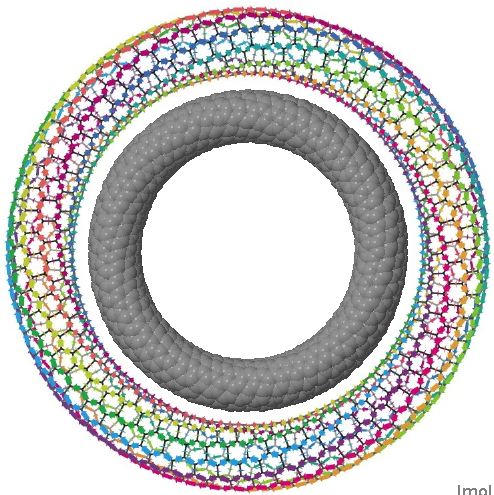
Carbon nanotorus. Click for 3D.
At 1364 carbon atoms, it is a little too big to calculate any of its expected chiroptical properties (the torus twists in a helical manner, and so is chiral). So we can only speculate whether e.g. its optical rotation would also be colossal! Or, what applications such a nanodevice might have. This post, by the way, was induced by seeing Steve Bachrach’s fascinating exploration of chiral nanohoops.
Author

References
- L. Liu, G.Y. Guo, C.S. Jayanthi, and S.Y. Wu, "Colossal Paramagnetic Moments in Metallic Carbon Nanotori", Physical Review Letters, vol. 88, 2002. https://doi.org/10.1103/physrevlett.88.217206
Tags: chiroptical, metallic carbon, nanotorus, Steve Bachrach
Perhaps some semi-empirics can give a glimpse at the chiroptical properties? ( ZINDO/S ) Maybe even PPP ?
The original magnetic properties were probed using π-orbital tight-binding theory (which is related to PPP theory). Chiroptical properties tend to focus on time-dependent density functional implementations (DOI: 10.1371/journal.pone.0010617; it might be that no-one has explored chiroptical properties using tight binding, π-only theories.
Tight-binding is the physicist’s extended hueckel theory, yes.
We have a TD-PPP (full RPA) code in our group, it gives nice (qualitative) results (eg. for large organic systems DOI: 10.1039/b925334c ). I know the ORCA program can do CIS with ZINDO/S, but not PPP. Dont even know if there is any freely available program that can still do (TD-)PPP.
I would give it a try, but I dont see how I can get a structure.
If you follow the procedure outlined at this post, you will be able to acquire access to the coordinates of the nanotorus. These may need further optimisation, but in any case might suffice to explore a TD-PPP calculation for this species?
[…] and with the current interest in the magnetic properties of graphene-like objects (see also this blog post and also the helical metal wire) such molecules can only help to excite our […]
[…] ‡Does the icon look familiar? See here. […]