White City is a small area in west london created as an exhibition site in 1908, morphing over the years into an Olympic games venue, a greyhound track, the home nearby of the BBC (British Broadcasting Corporation) and most recently the new western campus for Imperial College London.♣ The first Imperial department to move into the MSRH (Molecular Sciences Research Hub) building is chemistry. As a personal celebration of this occasion, I here dedicate three transition states located during my first week of occupancy there, naming them the White City trio following earlier inspiration by a string trio and their own instruments.
Posts Tagged ‘free energy barrier’
The “White City Trio” – The formation of an amide from an acid and an amine in non-polar solution (updated).
Wednesday, August 8th, 2018Tags:acetic acid, Acid, Amide, Amine, carboxylic acid, Chemistry, Company: BBC, Company: British Broadcasting Corporation, energy, Ester, exhibition site, free energy barrier, Functional groups, Hydrogen bond, Imperial College, Imperial College London, Ionic product, Newspaper & Magazine Printing Services, Non-ionic product, Olympic games, Organic chemistry, White City Trio
Posted in Interesting chemistry | 6 Comments »
Hydrogen capture by boron: a crazy reaction path!
Thursday, September 21st, 2017A recent article reports, amongst other topics, a computationally modelled reaction involving the capture of molecular hydrogen using a substituted borane (X=N, Y=C).[1] The mechanism involves an initial equilibrium between React and Int1, followed by capture of the hydrogen by Int1 to form a 5-coordinate borane intermediate (Int2 below, as per Figure 11).‡ This was followed by assistance from a proximate basic nitrogen to complete the hydrogen capture via a TS involving H-H cleavage. The forward free energy barrier to capture was ~11 kcal/mol and ~4 kcal/mol in the reverse direction (relative to the species labelled Int1), both suitably low for reversible hydrogen capture. Here I explore a simple variation to this fascinating reaction.∞
References
- L. Li, M. Lei, Y. Xie, H.F. Schaefer, B. Chen, and R. Hoffmann, "Stabilizing a different cyclooctatetraene stereoisomer", Proceedings of the National Academy of Sciences, vol. 114, pp. 9803-9808, 2017. https://doi.org/10.1073/pnas.1709586114
Tags:Ammonia borane, animation, Boranes, Chemistry, Cleaning Services, Company: React Group, free energy barrier, Hydroboration, Hydrogen, Matter
Posted in reaction mechanism | 1 Comment »
Autoionization of hydrogen fluoride.
Sunday, April 24th, 2016The autoionization of water involves two molecules transfering a proton to give hydronium hydroxide, a process for which the free energy of reaction is well known. Here I ask what might happen with the next element along in the periodic table, F.
Tags:dielectric, energy, Equilibrium chemistry, Fluorides, free energy, free energy barrier, Hydrogen bond, Hydronium, Inorganic solvents, Lithium fluoride, low energy final geometry corresponds, Oxides, PH, Properties of water, Self-ionization of water, Water, Water model
Posted in Interesting chemistry | 10 Comments »
Kinetic isotope effect models as a function of ring substituent for indole-3-carboxylic acids and indolin-2-ones.
Wednesday, January 20th, 2016The original strategic objective of my PhD researches in 1972-74 was to explore how primary kinetic hydrogen isotope effects might be influenced by the underlying structures of the transition states involved. Earlier posts dealt with how one can construct quantum-chemical models of these transition states that fit the known properties of the reactions. Now, one can reverse the strategy by computing the expected variation with structure to see if anything interesting might emerge, and then if it does, open up the prospect of further exploration by experiment. Here I will use the base-catalysed enolisation of 1,3-dimethylindolin-2-ones and the decarboxylation of 3-indole carboxylates to explore this aspect.
Tags:aqueous solution, Brian Challis, can construct quantum-chemical models, computed free energy barrier matches, Dan Singleton, free energy barrier, free energy barriers, Kinetic isotope effect, Organic chemistry, Physical organic chemistry, quantum-chemical models, supervisor
Posted in reaction mechanism | No Comments »
Allotropic halogens.
Sunday, April 26th, 2015Allotropes are differing structural forms of the elements. The best known example is that of carbon, which comes as diamond and graphite, along with the relatively recently discovered fullerenes and now graphenes. Here I ponder whether any of the halogens can have allotropes.
Tags:Allotropy, Bromine, Carbon, Chemical elements, Chemistry, free energy barrier, Fullerene, Halogen, Hypobromite, Matter, Nonmetals, Oxidizing agents, Oxygen, pence
Posted in reaction mechanism | 9 Comments »
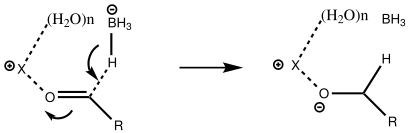
The mechanism of borohydride reductions. Part 1: ethanal.
Sunday, April 12th, 2015Sodium borohydride is the tamer cousin of lithium aluminium hydride (LAH). It is used in aqueous solution to e.g. reduce aldehydes and ketones, but it leaves acids, amides and esters alone. Here I start an exploration of why it is such a different reducing agent.
Tags:aqueous solution, Chemical bond, chemical bonding, Chemistry, Electronic effect, energy, final product, free energy barrier, Hydride, Hydrogen bond, immediate product, Lithium aluminium hydride, reduction
Posted in reaction mechanism | 2 Comments »
A computed mechanistic pathway for the formation of an amide from an acid and an amine in non-polar solution.
Wednesday, November 12th, 2014In London, one has the pleasures of attending occasional one day meetings at the Burlington House, home of the Royal Society of Chemistry. On November 5th this year, there was an excellent meeting on the topic of Challenges in Catalysis, and you can see the speakers and (some of) their slides here. One talk on the topic of Direct amide formation – the issues, the art, the industrial application by Dave Jackson caught my interest. He asked whether an amide could be formed directly from a carboxylic acid and an amine without the intervention of an explicit catalyst. The answer involved noting that the carboxylic acid was itself a catalyst in the process, and a full mechanistic exploration of this aspect can be found in an article published in collaboration with Andy Whiting's group at Durham.[1] My after-thoughts in the pub centered around the recollection that I had written some blog posts about the reaction between hydroxylamine and propanone. Might there be any similarity between the two mechanisms?
References
- H. Charville, D.A. Jackson, G. Hodges, A. Whiting, and M.R. Wilson, "The Uncatalyzed Direct Amide Formation Reaction – Mechanism Studies and the Key Role of Carboxylic Acid H‐Bonding", European Journal of Organic Chemistry, vol. 2011, pp. 5981-5990, 2011. https://doi.org/10.1002/ejoc.201100714
Tags:Andy Whiting, Dave Jackson, dielectric, Durham, energy profile, free energy barrier, London, non-polar solution, PDF, Royal Society of Chemistry
Posted in reaction mechanism | 6 Comments »
Benzene. As you have never seen it represented before!
Sunday, May 18th, 2014Continuing my european visits, here are two photos from Bonn. First, a word about how the representation of benzene evolved, attributed to Kekulé.
Tags:/RT, free energy barrier, gas constant
Posted in Historical | 3 Comments »
Caesium trifluoride: could it be made?
Saturday, November 23rd, 2013Mercury (IV) tetrafluoride attracted much interest when it was reported in 2007[1] as the first instance of the metal being induced to act as a proper transition element (utilising d-electrons for bonding) rather than a post-transition main group metal (utilising just s-electrons) for which the HgF2 dihalide would be more normal (“Is mercury now a transition element?”[2]). Perhaps this is the modern equivalent of transmutation! Well, now we have new speculation about how to induce the same sort of behaviour for caesium; might it form CsF3 (at high pressures) rather than the CsF we would be more familiar with.[3] Here I report some further calculations inspired by this report.
References
- X. Wang, L. Andrews, S. Riedel, and M. Kaupp, "Mercury Is a Transition Metal: The First Experimental Evidence for HgF<sub>4</sub>", Angewandte Chemie International Edition, vol. 46, pp. 8371-8375, 2007. https://doi.org/10.1002/anie.200703710
- M. Miao, "Caesium in high oxidation states and as a p-block element", Nature Chemistry, vol. 5, pp. 846-852, 2013. https://doi.org/10.1038/nchem.1754
Tags:animation, energy, free energy barrier, free energy change, metal, pence, post-transition main group metal, potential energy surface
Posted in Hypervalency, Interesting chemistry | 13 Comments »
Mechanism of the Boekelheide rearrangement
Wednesday, June 26th, 2013A reader asked me about the mechanism of the reaction of 2-picoline N-oxide with acetic anhydride to give 2-acetoxymethylpyridine (the Boekelheide Rearrangement[1]). He wrote ” I don’t understand why the system should prefer to go via fragmentation-recombination (… the evidence being that oxygen labelling shows scrambling) when there is an easy concerted pathway available (… a [3,3]sigmatropic shift). Furthermore, is it possible for two pathways to co-exist?” Here is how computation might enlighten us.
References
- A. Massaro, A. Mordini, A. Mingardi, J. Klein, and D. Andreotti, "A New Sequential Intramolecular Cyclization Based on the Boekelheide Rearrangement", European Journal of Organic Chemistry, vol. 2011, pp. 271-279, 2010. https://doi.org/10.1002/ejoc.201000936
Tags:ATM, CF 3 CO, CH 3 CO, extraneous product, free energy, free energy barrier, recombination
Posted in Interesting chemistry, pericyclic, reaction mechanism | 3 Comments »