Posts Tagged ‘free energy’
Thursday, April 25th, 2019
Previously, I explored (computationally) the normal vibrational modes of Co(II)-tetraphenylporphyrin (CoTPP) as a “flattened” species on copper or gold surfaces for comparison with those recently imaged[1]. The initial intent was to estimate the “flattening” energy. There are six electronic possibilities for this molecule on a metal surface. Respectively positively, or negatively charged and a neutral species, each in either a low or a high-spin electronic state. I reported five of these earlier, finding each had quite high barriers for “flattening” the molecule. For the final 6th possibility, the triplet anion, the SCF (self-consistent-field) had failed to converge, but for which I can now report converged results.†
(more…)
References
- J. Lee, K.T. Crampton, N. Tallarida, and V.A. Apkarian, "Visualizing vibrational normal modes of a single molecule with atomically confined light", Nature, vol. 568, pp. 78-82, 2019. https://doi.org/10.1038/s41586-019-1059-9
Tags:019-1059-9, 10.1038, Biomolecules, Chelating agents, chemical bonding, Chemical compounds, Chemistry, Coordination chemistry, Coordination complex, Copper, copper metal surface, Cu–CO, E-type, energy, free energy, higher energy, impossible free energy, Inorganic chemistry, Jahn–Teller effect, lowest energy electronic state, Metabolism, metal, metal surface, modest planarisation energy, Molecule, Natural sciences, Physical sciences, planarisation, Porphyrin, reasonable energy, Resonance, Solid-state chemistry, sufficient energy, Teller, Tetraphenylporphyrin
Posted in Interesting chemistry | 1 Comment »
Thursday, April 4th, 2019
Previously, I explored the Graham reaction to form a diazirine. The second phase of the reaction involved an Sn2′ displacement of N-Cl forming C-Cl. Here I ask how facile the simpler displacement of C-Cl by another chlorine might be and whether the mechanism is Sn2 or the alternative Sn1.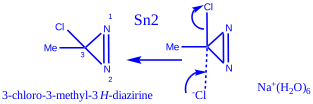 The reason for posing this question is that as an Sn1 reaction, simply ionizing off the chlorine to form a diazacyclopropenium cation might be a very easy process. Why? Because the resulting cation is analogous to the cyclopropenium cation, famously proposed by Breslow as the first example of a 4n+2 aromatic ring for which the value of n is zero and not 1 as for benzene.[1] Another example of a famous “Sn1” reaction is the solvolysis of t-butyl chloride to form the very stable tertiary carbocation and chloride anion (except in fact that it is not an Sn1 reaction but an Sn2 one!)
(more…)
References
- R. Breslow, "SYNTHESIS OF THE s-TRIPHENYLCYCLOPROPENYL CATION", Journal of the American Chemical Society, vol. 79, pp. 5318-5318, 1957. https://doi.org/10.1021/ja01576a067
Tags:animation, Carbenium ion, Cations, Chemical elements, chemical reaction, Chemistry, Chlorine, computational chemistry, Cyclopropenium ion, Diazirine, energy, energy profile, free energy, Halogens, Natural sciences, Nucleophilic aromatic substitution, Oxidizing agents, Physical sciences, potential energy surface, SN1 reaction, Substitution reactions
Posted in reaction mechanism | No Comments »
Monday, February 18th, 2019
Students learning organic chemistry are often asked in examinations and tutorials to devise the mechanisms (as represented by curly arrows) for the core corpus of important reactions, with the purpose of learning skills that allow them to go on to improvise mechanisms for new reactions. A common question asked by students is how should such mechanisms be presented in an exam in order to gain full credit? Alternatively, is there a single correct mechanism for any given reaction? To which the lecturer or tutor will often respond that any reasonable mechanism will receive such credit. The implication is that a mechanism is “reasonable” if it “follows the rules”. The rules are rarely declared fully, but seem to be part of the absorbed but often mysterious skill acquired in learning the subject. These rules also include those governing how the curly arrows should be drawn.† Here I explore this topic using the Graham reaction.[1]‡
(more…)
References
- W.H. Graham, "The Halogenation of Amidines. I. Synthesis of 3-Halo- and Other Negatively Substituted Diazirines<sup>1</sup>", Journal of the American Chemical Society, vol. 87, pp. 4396-4397, 1965. https://doi.org/10.1021/ja00947a040
Tags:/RT, activation energy, activation free energy, animation, arrow pushing, arrow-head, cellular telephone, Chemical kinetics, chemical reaction, Chemistry, computed energy, Ed Smith, energy, energy maximum, energy minima, energy plot, energy profile, energy surface, free energy, lecturer, mechanism, Natural sciences, Organic chemistry, overall reaction energy, Physical sciences, Reaction rate constant, Resonance, Transition state, Transition state theory, tutor, Tutorial
Posted in Curly arrows, Interesting chemistry | No Comments »
Saturday, February 24th, 2018
Another post inspired by a comment on an earlier one; I had been discussing compounds of the type I.In (n=4,6) as possible candidates for hypervalency. The comment suggests the below as a similar analogue, deriving from observations made in 1989.[1]
(more…)
References
- Y. Mazaki, and K. Kobayashi, "Structure and intramolecular dynamics of bis(diisobutylselenocarbamoyl) triselenide as identified in solution by the 77Se-NMR spectroscopy", Tetrahedron Letters, vol. 30, pp. 2813-2816, 1989. https://doi.org/10.1016/s0040-4039(00)99132-9
Tags:C, chemical bonding, Chemistry, free energy, Hypervalent molecule, Matter, Molecular geometry, Nature, Nitrogen
Posted in Hypervalency | 3 Comments »
Tuesday, November 28th, 2017
I started this story by looking at octet expansion and hypervalence in non-polar hypercoordinate species such as S(-CH3)6, then moved on to S(=CH2)3. Finally now its the turn of S(≡CH)2.‡
(more…)
Tags:1-Decyne, CH2, chemical bonding, free energy, G. N. Lewis, Lewis structure, Music, Octet
Posted in Historical, Hypervalency | 3 Comments »
Saturday, September 16th, 2017
Early in 2011, I wrote about how the diatomic molecule Be2 might be persuaded to improve upon its normal unbound state (bond order ~zero) by a double electronic excitation to a strongly bound species. I yesterday updated this post with further suggestions and one of these inspired this follow-up.
(more…)
Tags:Be-Be double bond, Be-Be triple bond, Chemical bond, Chemistry, Cs-Cs double bond, Diatomic molecule, free energy, General chemistry, K-K double bond, Li-Li double bond, Molecular geometry, Oxygen, Province/State: Be2, Quantum chemistry, Rb-Rb double bond, Stereochemistry
Posted in Interesting chemistry | 3 Comments »
Thursday, April 6th, 2017
Enols are simple compounds with an OH group as a substituent on a C=C double bond and with a very distinct conformational preference for the OH group. Here I take a look at this preference as revealed by crystal structures, with the theoretical explanation.
(more…)
Tags:Chemical bond, chemical bonding, Chemistry, Conformational isomerism, constrained search, Enol, free energy, Gauche effect, Hydrogen bond, Isomerism, Java, Physical organic chemistry, search query, Stereochemistry, Supramolecular chemistry
Posted in crystal_structure_mining, reaction mechanism | 2 Comments »
Thursday, March 2nd, 2017
The thread thus far. The post about Na2He introduced the electride anionic counter-ion to Na+ as corresponding topologically to a rare feature known as a non-nuclear attractor. This prompted speculation about other systems with such a feature, and the focus shifted to a tetrahedral arrangement of four hydrogen atoms as a dication, sharing a total of two valence electrons. The story now continues here.
(more…)
Tags:chemical bonding, Chemistry, Electride, free energy, Ion, Nature, Physical chemistry, Valence electron
Posted in Interesting chemistry | 1 Comment »
Monday, January 2nd, 2017
Here is an inside peek at another one of Derek Lowe’s 250 milestones in chemistry, the polymorphism of Ritonavir.[1] The story in a nutshell concerns one of a pharma company’s worst nightmares; a drug which has been successfully brought to market unexpectedly “changes” after a few years on market to a less effective form (or to use the drug term, formulation). This can happen via a phenomenon known as polymorphism, where the crystalline structure of a molecule can have more than one form.[2],[3],[4] In this case, form I was formulated into soluble tablets for oral intake. During later manufacturing, a new less-soluble form appeared and “within weeks this new polymorph began to appear throughout both the bulk drug and formulation areas“[1]
(more…)
References
- J. Bauer, S. Spanton, R. Henry, J. Quick, W. Dziki, W. Porter, and J. Morris, "Ritonavir: An Extraordinary Example of Conformational Polymorphism", Pharmaceutical Research, vol. 18, pp. 859-866, 2001. https://doi.org/10.1023/a:1011052932607
- J.D. Dunitz, and J. Bernstein, "Disappearing Polymorphs", Accounts of Chemical Research, vol. 28, pp. 193-200, 1995. https://doi.org/10.1021/ar00052a005
- D. Bučar, R.W. Lancaster, and J. Bernstein, "Disappearing Polymorphs Revisited", Angewandte Chemie International Edition, vol. 54, pp. 6972-6993, 2015. https://doi.org/10.1002/anie.201410356
- G.J.O. Beran, I.J. Sugden, C. Greenwell, D.H. Bowskill, C.C. Pantelides, and C.S. Adjiman, "How many more polymorphs of ROY remain undiscovered", Chemical Science, vol. 13, pp. 1288-1297, 2022. https://doi.org/10.1039/d1sc06074k
Tags:Carbamates, Chemistry, Derek Lowe, free energy, high energy process, High-energy rotations, higher energy, higher energy s-trans form, hydrogen bonding network, later manufacturing, Lipid polymorphism, low energy conformational effects, low energy rotations, lower energy rotation, Peek, Polymorphism, Protease inhibitors, Ritonavir, RTT, SN, Software engineering, Thiazoles, Ureas
Posted in Interesting chemistry | No Comments »
Sunday, September 11th, 2016
To quote from Wikipedia: in chemistry, a carbene is a molecule containing a neutral carbon atom with a valence of two and two unshared valence electrons. The most ubiquitous type of carbene of recent times is the one shown below as 1, often referred to as a resonance stabilised or persistent carbene. This type is of interest because of its ability to act as a ligand to an astonishingly wide variety of metals, with many of the resulting complexes being important catalysts. The Wiki page on persistent carbenes shows them throughout in form 1 below, thus reinforcing the belief that they have a valence of two and by implication six (2×2 shared + 2 unshared) electrons in the valence shell of carbon. Here I consider whether this name is really appropriate.
(more…)
Tags:Carbenes, chemical bonding, energy barrier, free energy, Functional groups, Ligand, Mesoionic carbene, Organometallic chemistry, Persistent carbene, quantum mechanical solution, Reactive intermediates, Transition metal carbene complex, Valence, Valence electron
Posted in crystal_structure_mining, General | 2 Comments »