Archive for the ‘Hypervalency’ Category
Sunday, October 4th, 2026
I posed[1] this question back in 2010: “(Almost) 100 years of Lewis[2] structures: are they still fit for purpose?”. I was reminded of this when I came across this relatively recent article[3] describing the structures of three binary sulfur-nitrogen anions, as shown in Figure 1 of their article. These are reproduced below (Scheme 1) along with an additional S/N molecule reported separately.[4]
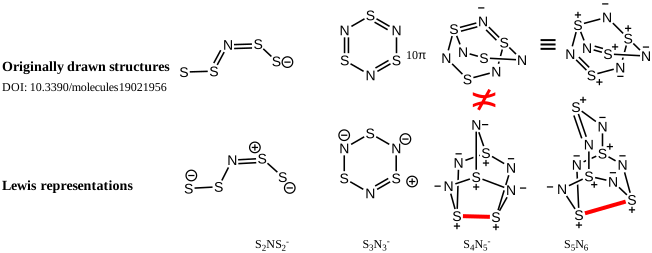 Scheme 1. Molecular structure representations of sulfur nitrides.
(more…)
References
- H. Rzepa, "(Almost) 100 years of Lewis structures: are they still fit for purpose?", 2010. https://doi.org/10.59350/rncje-xe063
- G.N. Lewis, "THE ATOM AND THE MOLECULE.", Journal of the American Chemical Society, vol. 38, pp. 762-785, 1916. https://doi.org/10.1021/ja02261a002
- R. Boeré, T. Roemmele, and M. Krall, "A Variable Temperature X-ray Diffraction Investigation of [PPN+][S4N5−]: Supramolecular Interactions Governing an Order/Disorder Transformation and the First High Resolution X-ray Structure of the Anion", Molecules, vol. 19, pp. 1956-1975, 2014. https://doi.org/10.3390/molecules19021956
- T. Chivers, and J. Proctor, "Preparation and crystal structure of a new sulphur nitride, S5N6; a molecular basket", Journal of the Chemical Society, Chemical Communications, pp. 642, 1978. https://doi.org/10.1039/c39780000642
Posted in General, Hypervalency | 4 Comments »
Monday, February 7th, 2022
Ever since the concept of a shared two-electron bond was conjured by Gilbert N. Lewis in 1916,[1] chemists have been fascinated by the related concept of a bond order (the number of such bonds that two atoms can participate in, however a bond is defined) and pushing it ever higher for pairs of like-atoms. Lewis first showed in 1916[1] how two carbon atoms could share two, four or six electrons to achieve a bond order of up to three. It took quite a few decades for this to be extended to four for carbon (and nitrogen) and that only with some measure of controversy and dispute (for one recent brief summary, see[2]).
(more…)
References
- G.N. Lewis, "THE ATOM AND THE MOLECULE.", Journal of the American Chemical Society, vol. 38, pp. 762-785, 1916. https://doi.org/10.1021/ja02261a002
- H.S. Rzepa, "Routes involving no free C
<sub>2</sub>
in a DFT-computed mechanistic model for the reported room-temperature chemical synthesis of C
<sub>2</sub>", Physical Chemistry Chemical Physics, vol. 23, pp. 12630-12636, 2021. https://doi.org/10.1039/d1cp02056k
Posted in Hypervalency | No Comments »
Sunday, March 18th, 2018
I have posted often on the chemical phenomenon known as hypervalency, being careful to state that as defined it applies just to “octet excess” in main group elements. But what about the next valence shell, occurring in transition metals and known as the “18-electron rule”? You rarely hear the term hypervalency being applied to such molecules, defined presumably by the 18-electron valence shell count being exceeded. So the following molecule (drawn in three possible valence bond representations) first made in 1992 intrigues.[1]
(more…)
References
- R. Ahlrichs, D. Fenske, H. Oesen, and U. Schneider, "Synthesis and Structure of [Ni(P<i>t</i>Bu<sub>6</sub>)] and [Ni<sub>5</sub>(P<i>t</i>Bu)<sub>6</sub>(CO)<sub>5</sub>] and Calculations on the Electronic Structure of [Ni(P<i>t</i>Bu)<sub>6</sub>] and (PR)<sub>6</sub>, R = <i>t</i>Bu,Me", Angewandte Chemie International Edition in English, vol. 31, pp. 323-326, 1992. https://doi.org/10.1002/anie.199203231
Posted in Hypervalency | 3 Comments »
Saturday, February 24th, 2018
Another post inspired by a comment on an earlier one; I had been discussing compounds of the type I.In (n=4,6) as possible candidates for hypervalency. The comment suggests the below as a similar analogue, deriving from observations made in 1989.[1]
(more…)
References
- Y. Mazaki, and K. Kobayashi, "Structure and intramolecular dynamics of bis(diisobutylselenocarbamoyl) triselenide as identified in solution by the 77Se-NMR spectroscopy", Tetrahedron Letters, vol. 30, pp. 2813-2816, 1989. https://doi.org/10.1016/s0040-4039(00)99132-9
Tags:C, chemical bonding, Chemistry, free energy, Hypervalent molecule, Matter, Molecular geometry, Nature, Nitrogen
Posted in Hypervalency | 3 Comments »
Friday, February 16th, 2018
Last year, this article[1] attracted a lot of attention as the first example of molecular helium in the form of Na2He. In fact, the helium in this species has a calculated‡ bond index of only 0.15 and it is better classified as a sodium electride with the ionisation induced by pressure and the presence of helium atoms. The helium is neither valent, nor indeed hypervalent (the meanings are in fact equivalent for this element). In a separate blog posted in 2013, I noted a cobalt carbonyl complex containing a hexacoordinate hydrogen in the form of hydride, H–. A comment appended to this blog insightfully asked about the isoelectronic complex containing He instead of H–. Here, rather belatedly, I respond to this comment!
(more…)
References
- X. Dong, A.R. Oganov, A.F. Goncharov, E. Stavrou, S. Lobanov, G. Saleh, G. Qian, Q. Zhu, C. Gatti, V.L. Deringer, R. Dronskowski, X. Zhou, V.B. Prakapenka, Z. Konôpková, I.A. Popov, A.I. Boldyrev, and H. Wang, "A stable compound of helium and sodium at high pressure", Nature Chemistry, vol. 9, pp. 440-445, 2017. https://doi.org/10.1038/nchem.2716
Tags:chemical bonding, Chemical elements, chemical shift, Chemistry, helium, Hydride, Hydrogen, Hypervalent molecule, Matter, Metal hydrides, Reducing agents, Transition metal hydride
Posted in Hypervalency | 4 Comments »
Saturday, January 13th, 2018
I discussed the molecule the molecule CH3F2- a while back. It was a very rare computed example of a system where the added two electrons populate the higher valence shells known as Rydberg orbitals as an alternative to populating the C-F antibonding σ-orbital to produce CH3– and F–. The net result was the creation of a weak C-F “hyperbond”, in which the C-F region has an inner conventional bond, with an outer “sheath” encircling the first bond. But this system very easily dissociates to CH3– and F– and is hardly a viable candidate for experimental detection. In an effort to “tune” this effect to see if a better candidate for such detection might be found, I tried CMe3F2-. Here is its story.
(more…)
Tags:Antibonding molecular orbital, candidate for experimental detection, chemical bonding, chemical shift, Chemistry, metal, Molecular orbital, Nature
Posted in Hypervalency | 2 Comments »
Tuesday, December 26th, 2017
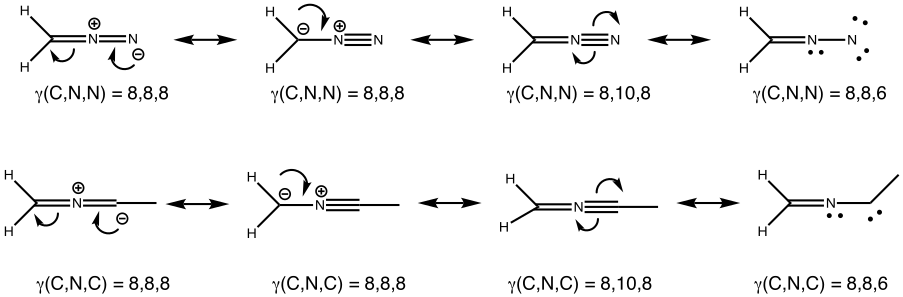
Recollect the suggestion that diazomethane has hypervalent character[1]. When I looked into this, I came to the conclusion that it probably was mildly hypervalent, but on carbon and not nitrogen. Here I try some variations with substituents to see what light if any this casts.
(more…)
References
- M.C. Durrant, "A quantitative definition of hypervalency", Chemical Science, vol. 6, pp. 6614-6623, 2015. https://doi.org/10.1039/c5sc02076j
Tags:chemical bonding, Chemistry, diazo, Diazo compounds, Diazomethane, diazomethane-like systems, Functional groups, Hypervalent molecule, Molecular geometry, Organic chemistry, Recollects
Posted in Hypervalency | 8 Comments »
Saturday, December 23rd, 2017
In the previous post, I referred to a recently published review on hypervalency[1] which introduced a very simple way (the valence electron equivalent γ) of quantifying the effect. Diazomethane was cited as one example of a small molecule exhibiting hypervalency (on nitrogen) by this measure. Here I explore the effect of substituting diazomethane with cyano and nitro groups.‡
(more…)
References
- M.C. Durrant, "A quantitative definition of hypervalency", Chemical Science, vol. 6, pp. 6614-6623, 2015. https://doi.org/10.1039/c5sc02076j
Tags:candidate for hypervalent carbon, chemical bonding, Hypervalent molecule, Molecular geometry
Posted in Hypervalency, Interesting chemistry | No Comments »
Sunday, December 17th, 2017
Alkalides are anionic alkali compounds containing e.g. sodide (Na–), kalide (K–), rubidide (Rb–) or caeside (Cs–). Around 90 examples can be found in the Cambridge structure database (see DOI: 10.14469/hpc/3453 for the search query and results). So what about the ammonium analogue, ammonide (NH4–)? A quick search of Scifinder drew a blank! So here I take a look at this intriguingly simple little molecule.‡
(more…)
Tags:Alkalide, Ammonium, Anions, Atomic physics, Chemistry, electron gas, energy, free-electron gas, Jahn-Teller, kinetic energy density, Matter, Nitrogen, potential energy surface, search query
Posted in Hypervalency | 2 Comments »